
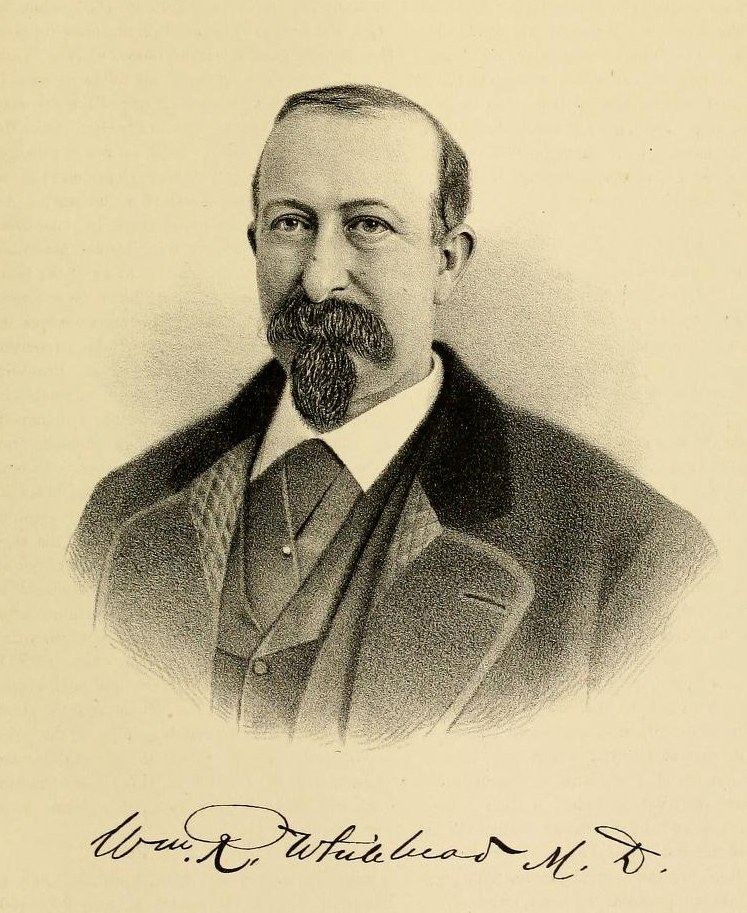
Dr William R. Whitehead
The Whitehead-Peabody Mansion’s first owner was Dr. William Riddick Whitehead.
Included in the mansion’s long-told ghost stories are those of deceased and wounded soldiers who allegedly followed Dr. Whitehead to his home at 1128 Grant St in Denver, Colorado. Dr. Whitehead is said to have dealt with recurring nightmares of the things he saw, and ghost legends tell of spirits unwilling to leave the man with whom they last came in contact, the army surgeon unable to save their lives. Further, these war-spirits did not leave when Dr. Whitehead died; reports of Whitehead’s ghosts throughout the decades include figures wearing army uniforms and books flying off shelves.
Dr. Whitehead, born in Suffolk, Virginia in 1931, spent his life practicing medicine. Dr. Whitehead famously served in the Russian Army as a surgeon in the Crimean War from 1854 -1855. He was knighted into the Imperial Order of Stanislaus by the Russian Empire in recognition of his service.
Following the Crimean war, and after his second medical degree obtained at the School of Medicine in Paris, France, Dr. Whitehead returned to the United States and enlisted in the Confederate Army. At 30 years old, he was appointed surgeon of the Provisional Army of the Confederate States in July of 1861.
Dr. Whitehead tended to soldiers from the front lines of the Confederate charge during the most intense battles of the Civil War. At the Battle of Chancellorsville, Lt. General “Stonewall” Jackson was mistakenly fired upon by his own army. Dr. Whitehead personally placed mortally wounded Jackson into the ambulance and tended to his wounds, including his amputated arm.
Dr. Whitehead reportedly ordered whiskey for the sick and wounded, and endured appalling conditions, including Camp Moss Neck, VA with mud so intense the “whole bottom of the earth seemed to have sunk about three feet.” He undoubtedly said final goodbyes to many men whose last days were on the battlefield.
Dr. Whitehead served in the bloody war until he was captured in Gettysburg, PA on July 4, 1863, exactly two years after he enlisted. 50 days later, Dr. Whitehead escaped the low-security imprisonment at Fort McHenry, Maryland.
In December of the same year, the day before he turned 32 years old, he penned a letter requesting a leave of absence from the 44th VA Infantry, Richmond, VA.
The leave of absence was granted, and 10 days later Dr. Whitehead married his cousin Elizabeth “Eliza” Flynn Benton in his hometown of Suffolk, Virginia on December 24, 1863. The wedding must have been quite the family affair. Dr. Whitehead did not return to the battlefield.
Following the end of the Civil War, he moved to New York City to practice medicine. He then moved his family to Denver in 1872. Some sources say he moved to Denver to preserve his own health, and some accounts mention he moved due to the poor health of his wife and son.
Dr. Whitehead was the author of many works on medicine and surgery. He was a co-founder of the University of Denver’s Denver College of Medicine and was a professor of anatomy at the University of Colorado, Boulder from 1884-1886.
In 1889 Dr. Whitehead commissioned the project that was to be his forever home, the Whitehead Mansion. William and Eliza’s children Charles B., Frank, and Florence Benton were 18, 15, and 12 respectively the year the mansion was commissioned.
According to newspapers from the time, the Whitehead family was quite socially active, and they were prominent members of the Denver community. Dr. and Mrs. Whitehead were well known for hosting luncheons, musical performances, fund-raisers, and varied social gatherings with a flare of hearty southern hospitality in their beautiful home at 1128 Grant St.
Dr. Whitehead continued to practice medicine and enjoy an active family and social life in the Denver and Boulder area until his untimely death at his home on October 13, 1902 at 70 years old.
Newspapers reported his death with accolades for his military service in both the Crimean War and dedication to the Confederate Army during the Civil War, as well as his service to the medical community as a distinguished physician, surgeon, and professor.